How Do custom hydraulic hoses Perform in Suction and Return Lines?
Custom hydraulic hoses can work well in suction and return lines when hose ID, vacuum rating, flow rate, oil temperature, fittings, and routing are matched to the circuit. Suction lines often run below atmospheric pressure, so collapse resistance and low inlet restriction matter more than high working pressure. A 1-inch hose has about 78% more internal area than a 3/4-inch hose, reducing fluid velocity at the same flow rate. Return lines usually carry low positive pressure but can see short pressure surges, especially during cold starts. SAE J517 hose specifications and ISO 4413:2010 system guidance are commonly used when selecting hydraulic hose assemblies.
A suction hose works between the reservoir and the pump inlet, where pressure may fall below atmospheric pressure. The hose wall therefore needs enough reinforcement to keep its circular shape when external atmospheric pressure is greater than internal pressure. A pressure hose that handles 3,000 psi in positive-pressure service is not automatically suitable for vacuum service because its reinforcement may be designed mainly to contain outward force. SAE J517 includes multiple hose constructions, while manufacturers separately publish vacuum limits for products intended for suction use.
That difference becomes more important as pump flow increases because pressure loss rises with velocity, hose length, oil viscosity, fittings, and changes in direction. Increasing ID from 3/4 inch to 1 inch raises cross-sectional flow area from about 0.442 to 0.785 square inches, an increase of roughly 78%. At an unchanged flow rate, fluid velocity therefore drops by about 44%, before fitting restrictions are considered.
A suction hose should be sized around pump inlet conditions, not around pump discharge pressure. A hose with a large pressure rating can still perform poorly if its bore is too small or its vacuum resistance is inadequate.
Oil temperature adds another layer to suction sizing. ISO VG 46 hydraulic oil has a nominal kinematic viscosity of 46 mm²/s at 40°C, but viscosity can rise several times above that level during a cold start. Thicker oil produces more pressure loss through the hose, elbow fittings, strainers, and reservoir outlet. Systems installed outdoors in northern US or Canadian climates may therefore need a larger suction line than equipment operating near 20°C throughout the year.
Pump manufacturers commonly publish minimum inlet-pressure or maximum permissible vacuum conditions because cavitation can begin before a hose shows any visible damage. Cavitation occurs when local pressure drops low enough for vapor cavities to form in the fluid. Their collapse creates noise, vibration, surface erosion, and unstable lubrication conditions around pump components. A 2020-era mobile hydraulic system may use pumps with much higher power density than older equipment, making inlet design less tolerant of undersized plumbing even when reservoir volume has not changed.
The hose fittings also matter because nominal hose ID does not guarantee the same free-flow area through every coupling. A 1-inch hose connected through an adapter with a much smaller internal passage may still create substantial restriction. Elbows, reducers, shutoff valves, and reservoir strainers add local losses, so a short hose with four restrictive fittings may perform worse than a slightly longer assembly using two full-flow connections.
Return lines operate differently because fluid normally moves toward the reservoir under positive pressure. Steady return pressure may be far below the 2,000–5,000 psi seen on many equipment pressure circuits, yet return pressure can rise when filters become restricted, oil is cold, valves switch rapidly, or several actuators discharge at the same time. A hose rated only from average operating pressure can therefore be underspecified for short-duration conditions.
Cylinder geometry is one reason return flow may exceed pump flow. A differential cylinder has a piston rod on one side, so the effective fluid area is different between the cap end and rod end. During retraction, oil entering the smaller rod-side area can force a larger volume out of the cap side. Depending on rod-to-bore dimensions, return flow can exceed inlet flow by 20%, 40%, or more, which needs to be considered before selecting hose ID.
| Design item | Suction line | Return line |
|---|---|---|
| Main pressure condition | Partial vacuum | Low-to-moderate positive pressure |
| Main sizing concern | Pump inlet restriction | Return flow and backpressure |
| Hose structure | Vacuum-resistant reinforcement | Pressure-rated reinforcement |
| Typical concern at cold start | High inlet restriction | Higher backpressure |
| Fitting effect | Very high | High |
| Pressure surges | Usually secondary | Must be checked |
| Air leakage | Serious concern | Less common concern |
Air leakage deserves special attention on the suction side because a connection may admit air without leaking visible oil. A loose fitting, damaged seal, cracked hose cover, or poor connection can draw outside air into a line that is below atmospheric pressure. Entrained air reduces the effective bulk modulus of hydraulic fluid, so actuator response can become less stable. Even a small amount of aeration can also cause reservoir foaming and change how consistently the pump receives oil.
Return hoses face a different maintenance issue: oil returning from cylinders, motors, valves, coolers, or filters may carry more heat than fluid leaving the reservoir. Common petroleum hydraulic oils may operate around 40–70°C in many mobile and industrial machines, but hose compounds have their own continuous and intermittent temperature limits. Running a hose repeatedly near its upper temperature rating can accelerate hardening of the tube and cover, especially near engines, exhaust components, or poorly ventilated compartments.
Material compatibility should therefore be checked together with temperature. Nitrile-based inner tubes are widely used with mineral hydraulic oils, while other compounds may be selected for synthetic fluids, water-glycol fluids, biodegradable hydraulic fluids, or demanding temperature ranges. Compatibility data from the hose manufacturer is more useful than assuming all hydraulic hoses tolerate the same fluid. A fluid change introduced during a 5-year equipment service life can alter hose compatibility even when system pressure stays unchanged.
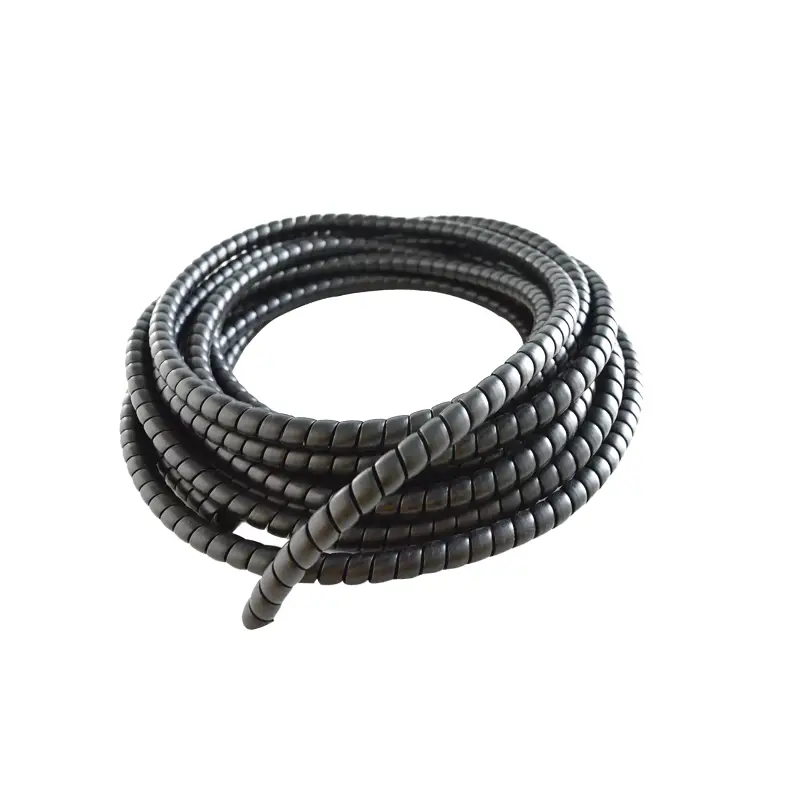
Outside the tube, cover material has a separate job. Abrasion against brackets, frames, guards, or neighboring hoses can remove the outer cover and expose reinforcement. Hose abrasion sleeves can help where movement is unavoidable, but routing normally gives better long-term results than relying only on extra protection. A hose rubbing 10 times per machine cycle can experience thousands of contact events during one work shift on high-cycle equipment.
Custom hose length can reduce those contact problems because the assembly can be built for a specific route rather than selected from the nearest standard length. Too much hose creates loops that can rub or move excessively. Too little hose can pull against fittings or force the hose below its minimum bend radius. Hose manufacturers publish minimum bend radius data because bending too tightly can flatten the bore and place uneven stress on reinforcement.
Fitting orientation also affects routing. A 45-degree or 90-degree end connection may remove a tight bend immediately after the port, although the fitting itself can add pressure loss. The designer has to compare space, flow area, and bend radius instead of assuming a straight fitting always performs better. On compact mobile equipment produced after 2015, dense component packaging has made fitting orientation increasingly relevant because pumps, filters, valves, coolers, and electrical hardware often occupy the same small enclosure.
Custom assemblies also make it easier to choose different construction for two lines that appear similar from outside. A suction hose may use helical reinforcement to resist collapse, while a return hose may use textile braid or another construction appropriate for its pressure level and flexibility requirement. Some industrial rubber hoses are also built for oil transfer or suction service, but industrial hose and hydraulic hose should not be treated as interchangeable categories without checking pressure, vacuum, fluid, temperature, and fitting requirements.
Pressure rating remains important on return hoses because transient pressure can be substantially higher than reservoir pressure. A return filter that accumulates contamination, for example, increases differential pressure until the bypass valve opens if a bypass is fitted. During startup at 0°C or below, high-viscosity oil can produce much greater restriction than the same circuit at 50°C. Hose, filter, cooler, and fitting ratings should therefore be reviewed as one flow path.
Service environment adds another selection layer. Agricultural machines may expose hoses to mud, fertilizers, ultraviolet light, and frequent movement, while factory equipment may see cutting fluids, metal chips, or repetitive flexing. Construction machinery can place hose assemblies close to hot surfaces and abrasive debris. A hose that lasts 5 years in a stationary power unit may have a much shorter service interval in an articulated boom where it flexes hundreds of times per day.
Manufacturing quality also affects performance after the hose type has been selected. Hydraulic hose and fittings are normally engineered as compatible systems because crimp diameter, stem geometry, ferrule design, and hose construction must work together. A crimp that is outside the manufacturer’s specified diameter can reduce retention or damage the hose tube. SAE J1273, revised several times since its original publication, provides widely used guidance on hydraulic hose selection, routing, fabrication, installation, replacement, and maintenance.
Visual inspection should include abrasion, exposed reinforcement, cracked covers, leakage, damaged fittings, excessive twisting, and movement at the coupling. Inspection frequency depends on equipment duty rather than one universal interval. A continuously operated 24-hour industrial machine and a seasonal piece of equipment do not accumulate hose cycles at the same rate, even if both use the same SAE hose family.
For specification work, flow rate, fluid type, minimum and maximum temperature, maximum pressure, vacuum requirement, hose ID, fitting size, fitting orientation, routing length, bend radius, and environmental exposure should be recorded before assembly. A system flowing 30 US gallons per minute through a 1-inch line is not hydraulically equivalent to a system flowing 15 gallons per minute through the same hose, because velocity doubles when flow doubles while the internal area remains unchanged.
One final sizing check should compare the hose bore with every fitting and component in the same path. Increasing hose diameter by 25% provides much less benefit when a reducer, valve, or adapter remains the smallest passage. Suction and return performance depend on the complete flow path, so hose construction, fitting geometry, oil condition, installation temperature, and actual operating flow should be evaluated together under the guidance of SAE J517, SAE J1273, ISO 4413:2010, and the hose manufacturer’s published ratings.