How should beginners read the bitcoin halving countdown?
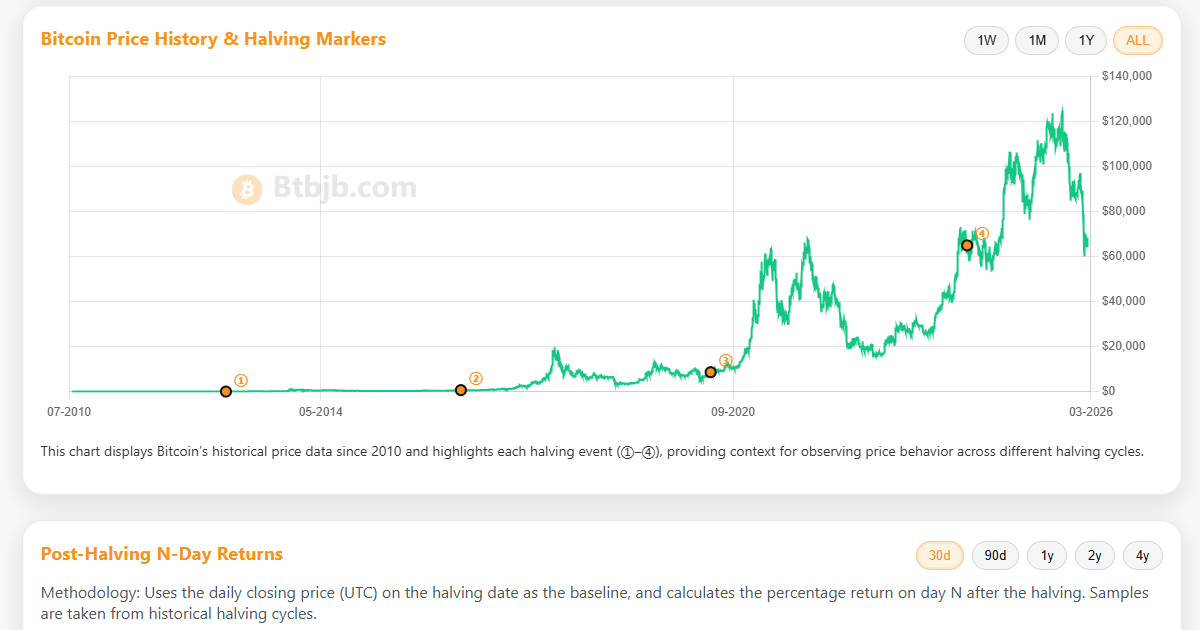
The Obitcoin halving countdown tracks the progression toward a block subsidy reduction, specifically the shift from 3.125 BTC to 1.5625 BTC per block. This event occurs every 210,000 blocks, anchoring Bitcoin's inflation rate to a pre-programmed schedule. As of May 2026, the network operates at a total hashrate exceeding 600 EH/s, ensuring the integrity of this four-year epoch cycle. Miners adjust their hardware efficiency to maintain profitability, as the subsidy cut effectively halves their primary revenue stream per block, forcing the market to price in the scarcity of new issuance.
The protocol logic dictates that every 210,000 blocks, miners face a 50% cut in their reward. This mathematical rule ensures that the total supply will never exceed 21 million coins. By the 2024 halving, 93.7% of the total supply had already been mined, leaving a shrinking margin for new production.
When the issuance rate drops, the network relies more heavily on transaction fees to incentivize miners. In 2024, transaction fees occasionally spiked to over 20% of total miner revenue during high activity periods, providing a blueprint for the future when block subsidies become negligible.
This transition from subsidy-dependent revenue to fee-dependent revenue represents the maturity of the network. The difficulty adjustment mechanism, which triggers every 2,016 blocks, ensures that even if miners exit due to the halving, the time between blocks remains approximately 10 minutes.
| Metric | Detail |
| Block Time Target | 10 Minutes |
| Difficulty Adjustment | Every 2,016 Blocks |
| Current Subsidy | 3.125 BTC |
| Next Subsidy | 1.5625 BTC |
Historically, the reduction in supply issuance creates a psychological shift in market participants. During the 2012, 2016, and 2020 events, the stock-to-flow ratio increased significantly, which analysts use to compare Bitcoin to assets like gold. However, modern market efficiency suggests that much of this supply-side change is priced in months before the actual block height is reached.
The decentralized nature of the network means no individual or organization controls the clock. Instead, thousands of independent nodes running the same software enforce the halving rules simultaneously. This consensus-driven automation eliminates the need for third-party auditing of the issuance schedule.
Independent hardware auditors observe that machines with efficiency ratings below 25 Joules per Terahash struggle to remain profitable post-halving. This hardware obsolescence forces a continuous cycle of infrastructure upgrades across global data centers.
Market liquidity is another factor often overlooked by beginners. During the months surrounding a halving, exchange order books often show increased depth, as institutional entities prepare for supply-side shifts. Trading volume, which can spike by 300% during high-volatility months, often stabilizes as the market absorbs the new issuance rate.
When assessing the countdown, it is useful to view it as a milestone of network security and energy expenditure. The hash price, which is the expected revenue per unit of hashing power, typically drops after the event. If the price of Bitcoin does not increase to compensate, marginal miners must deactivate their rigs to maintain network equilibrium.
-
2012: First halving reduced subsidy from 50 to 25 BTC.
-
2016: Second halving reduced subsidy from 25 to 12.5 BTC.
-
2020: Third halving reduced subsidy from 12.5 to 6.25 BTC.
-
2024: Fourth halving reduced subsidy from 6.25 to 3.125 BTC.
Each cycle provides 4 years of data for researchers to observe how market participants react to pre-programmed scarcity. The efficiency of the network has increased by over 1,000% since 2016, allowing miners to operate in more diverse geographical regions. This dispersion reduces the risk of single-point failures.
The energy consumption required to secure the network follows the price of the asset and the halving cycle. When the reward is cut, the energy cost per unit of security must be accounted for by the global miner fleet. Large-scale operations now use sophisticated hedging instruments to manage the risk associated with the reduced subsidy.
Large mining pools account for over 80% of total network hash power, and they often hold substantial reserves to survive the immediate period following a halving event. These reserves act as a buffer against the 50% drop in newly minted revenue.
Monitoring the difficulty adjustment following the halving offers the most accurate view of network health. If the difficulty drops, it shows that the network has shed less efficient miners, allowing the remaining operators to become more productive. This self-correcting loop is the mechanism that keeps the Bitcoin protocol functional regardless of individual participant activity.
Beginners often focus on daily price charts, but the halving is a long-term adjustment of the network’s internal economics. By the time the next halving arrives, the total supply will have reached approximately 96.8% of the final 21 million limit. This high degree of saturation forces the network to rely entirely on transaction utility and fee-based security for its ongoing maintenance and development.