Latency and Patience: Realistic Turnarounds
Waiting is part of any chat interface, and the wait is shorter or longer for reasons you can mostly predict. Reply time moves with how much context the thread carries, how long your own message is, how busy the platform is at that hour and how stable your connection is. An illustrative fifteen seconds per reply turns a sixty-message session into about fifteen minutes of elapsed time; thirty seconds turns it into half an hour.

Key takeaways
- Four factors decide turnaround: context length, your message length, platform load and your own connection.
- Plan in elapsed time. A 60-message session is about 15 minutes at 15 seconds per reply and 30 minutes at 30 seconds.
- Do not send again while a reply is generating; a second message reshapes the answer already in progress.
- Session timing matters more than session length at peak hours, so move a long thread to a quiet window.
The four factors behind a slow reply
Context length is the first and least obvious. A thread carrying hundreds of messages gives the system more to work with, which is exactly why it produces better continuity and also why replies take longer to compose. The trade is real, and it is the reason a long thread can feel slower than a fresh one without anything being wrong.
Your own message is the second factor. A long, detailed message asks for a longer answer and takes longer to process, while a two-line message returns quickly. If you are waiting on every turn, shortening the messages rather than abandoning the thread usually restores the rhythm.
Platform load and connection quality are the other two, and they are the ones least under your control. Peak hours concentrate demand, and an unstable connection adds time to both directions. Both are situational, which means the same thread can feel fast in the morning and sluggish in the evening.
What to do while waiting
The single most useful rule is not to send again while a reply is being generated. A second message arrives as part of the same context and shapes the answer already in progress, so the reply you eventually read answers a question you changed halfway through asking. One message, then wait.
If a wait stretches past what you expected, check the input before the platform. It is almost always one of the four factors rather than a fault: a very long message, a very long thread, a busy hour, a weak signal. Reducing any one of them is faster than reloading a session and losing the context.
Then use the wait. A short pause is a reasonable moment to plan the next message rather than typing it immediately, and the replies that follow a considered message are consistently better than the ones that follow a reflexive one. Patience here is not passive; it is part of the input.
Two smaller habits also help. Keep long messages for when you have time to read a long reply, and keep short ones for the fifteen minutes before you leave the house. And if a session feels slow from the first message rather than developing that way later, treat the network as the suspect before the platform, because the first reply is generated under the lightest context load of the whole conversation.
Do not conclude much from one slow session. Turnaround varies with hour, network and message size, so a single sluggish evening is a data point rather than a pattern. Note three slow sessions across a fortnight and you have a pattern; note one and you have a Tuesday.
| Factor | Direction of effect | Under your control? |
|---|---|---|
| Thread context length | Longer history, longer turnaround | Partly, by starting a thread or checkpointing it |
| Message length | Longer message, longer reply | Yes, immediately |
| Platform load at that hour | Busier hour, slower reply | Yes, by choosing the session window |
| Connection quality | Unstable link adds delay both ways | Yes, by moving to a stable network |
| Sending a second message early | Reshapes the reply in progress | Yes, by simply not doing it |
Only one row of that table requires a decision before the session starts, namely when you sit down. Everything else is adjustable in the moment, which is why a slow patch is rarely a reason to abandon a conversation.
Worked example: elapsed time for a full session
Build the estimate from the message count. At an illustrative 15 seconds per reply, a 60-message session takes 900 seconds of turnaround, which is 15 minutes. At 30 seconds per reply the same session takes 1,800 seconds, or 30 minutes. Neither figure includes your own thinking time, so both are floors rather than totals.
Scale that across a habit. A moderate month of 20 sessions at 15 minutes is 300 minutes, or five hours. The same month with slower replies at 30 minutes per session is 600 minutes, or ten hours - the doubling comes entirely from turnaround, not from anything the reader changed about their own behaviour.
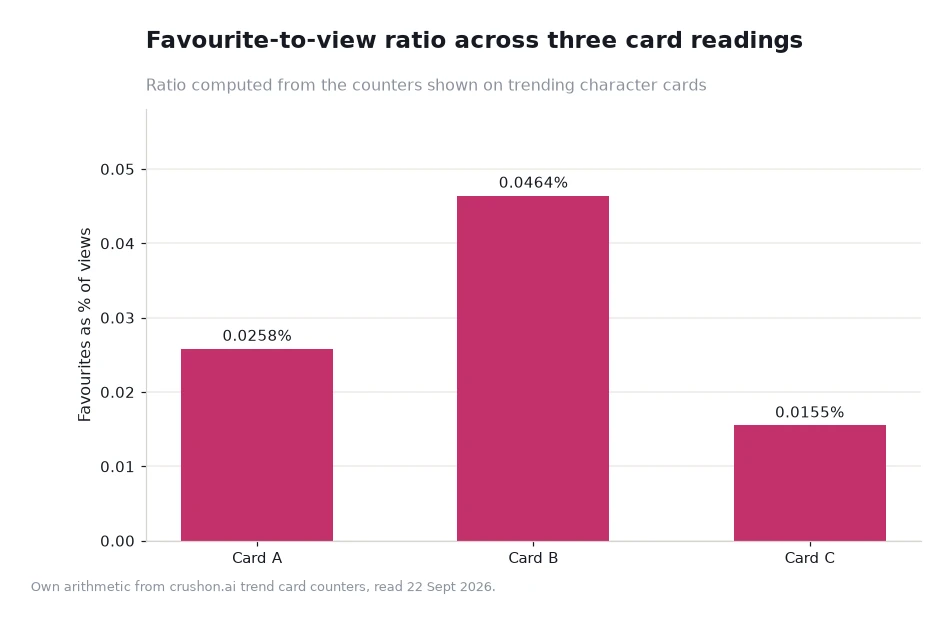
There is a second measure worth watching, which is how the catalogue as a whole converts attention. Saves as a share of views read 0.0258%, 0.0464% and 0.0155% across three card readings, or 2.58, 4.64 and 1.55 saves per 10,000 views. The card at 0.0464% is being revisited by close to three times as many readers as the one at 0.0155%, which is the same principle applied to patience: the things worth waiting for are the things people return to.
Choosing a session window
Timing is the lever most readers never touch. If a long thread feels sluggish in the evening and responsive in the morning, the difference is load rather than the thread, and moving the session is a better fix than shortening it. A weekly rhythm that puts long conversations in quiet windows and short ones anywhere works well for most people.
It also helps to know what the format is for. The platform's own page for porn ai chat, which it presents under the heading Porn Chat AI, describes the interactions as natural and adaptive, with characters that recall earlier exchanges, and a conversation built for that kind of continuity is worth waiting a few extra seconds for. The AI chat blog covers adjacent practical ground if you want to compare habits.
Set expectations from the arithmetic, choose the window, and send one message at a time. That combination removes almost every frustrating wait from a month of use.
Frequently asked questions
Why are replies slower in a long thread?
More context has to be considered before an answer is composed. That is the same property that makes continuity work, so a degree of slowdown is the price of a thread worth keeping.
Should I resend if a reply is taking a long time?
No. A second message joins the context and changes the answer being composed, so you will not get the reply you asked for. Wait, then send one message.
Does session timing really make a difference?
It can, because demand concentrates at busy hours. If a thread consistently feels slower in the evening, try the same session earlier and compare.
Plan the wait, then get on with it
Estimate turnaround from context length and your own message, pick a quiet window for the long threads, and never send twice in one turn. The result is a session whose elapsed time matches your expectations, which is all patience really requires. Written for an adult readership of 18 and above.
Sources: the interaction wording and the trending counters behind the 0.0258%, 0.0464% and 0.0155% ratios were read from Crushon on 22 Sept 2026. Reply timings and the per-session minute estimates are illustrative assumptions created for this article rather than measured platform performance.[1]