A Practical Guide to Comparing Medical Supply Samples and Specifications
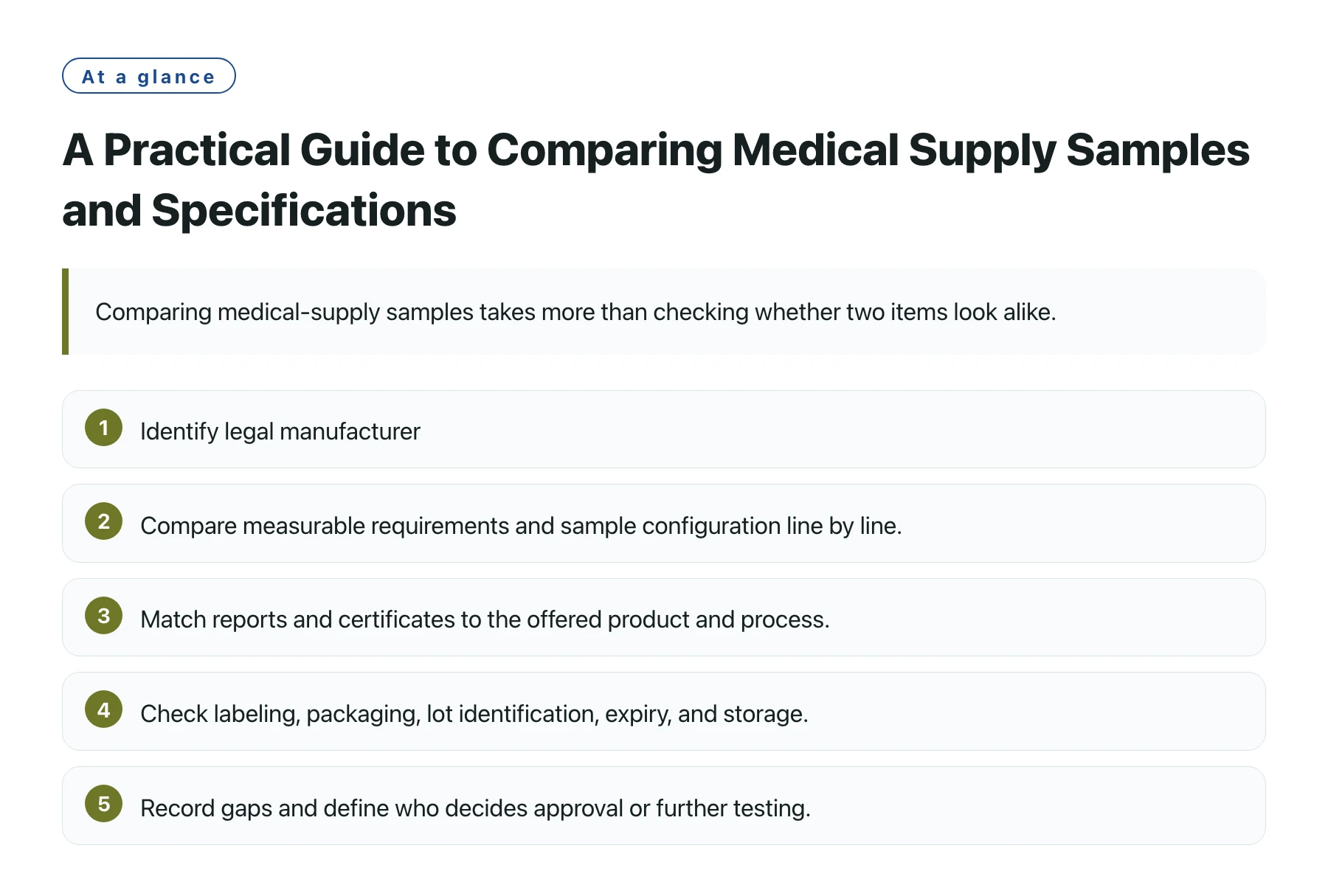
Comparing medical-supply samples takes more than checking whether two items look alike. Buyers need to align product identity, intended use, materials, dimensions, function, packaging, evidence, and market obligations. Record the exact sample and specification revision for each candidate, then assign qualified owners to unresolved technical or regulatory questions.
Key takeaways
- Identify legal manufacturer, factory, model, revision, intended use, and market.
- Compare measurable requirements and sample configuration line by line.
- Match reports and certificates to the offered product and process.
- Check labeling, packaging, lot identification, expiry, and storage.
- Record gaps and define who decides approval or further testing.
A seasonal order plan works when demand signals, factory commitments, and delivery dates stay distinct and visible.
1. Create a comparison record for each candidate
Record supplier, legal manufacturer, production site, model, revision, item code, sample date, lot, intended use, and destination. Separate prototype, reference sample, and production-intent status. Ask where each sample was assembled and whether any part was hand-selected.
Keep the sample label, quote, drawing, and report linked. A shared product name can conceal different configurations or sources.
For a medical supply, include intended user and care setting, expected use frequency, cleaning or reprocessing assumptions, storage range, and any compatible accessories. A sample that looks identical can differ in packaging configuration or included components. Photograph identifiers and keep an untouched reference unit where practical. Record who selected the samples so the comparison set can be traced back to supplier quotes.
2. Normalize the specification
Set one comparison baseline for dimensions, materials, composition, function, tolerances, accessories, packaging, labels, and instructions. State methods and units. Ask each supplier to respond with conforming, exception, evidence, or not applicable for every item.
If a requirement is unclear, assign a technical owner rather than letting suppliers interpret it differently. Record which buyer specifications are mandatory and which allow approved alternatives.
3. Test function under consistent conditions
Plan the same setup, operator actions, test duration, instruments, sample count, and acceptance limits for each candidate. Document conditions and results. For specialized products, use laboratories or technical specialists with suitable methods.
A demonstration is not a full reliability or safety evaluation. State what was not tested, whether the test was destructive, and which claims need separate evidence.
Write down pass, fail, and borderline results before comparing suppliers. If repeatability matters, test more than one unit and state how units were selected. Use calibrated equipment when the measurement affects acceptance. A short functional check can screen obvious differences, while risk-based testing may require a separate protocol, qualified laboratory, or clinical and regulatory review.
4. Review materials and product-contact features
Compare material grades, coatings, adhesives, fluid paths, contact surfaces, and component sources when relevant. Ask for declarations, test reports, or supplier evidence tied to the exact model and production site. Confirm any claimed compatibility with the intended conditions.
Do not infer suitability from a generic materials sheet. For patient-contact, sterile, or chemically exposed products, have the qualified owner determine applicable evaluation requirements.
5. Verify regulatory and quality documents
Match reports, registrations, certificates, declarations, and approvals to product identity, market, manufacturer, model, revision, date, method, and scope. Ask what each document proves and what it does not. Independently verify key claims with the issuing organization or official source where available.
For U.S. medical devices, FDA states that foreign manufacturers must meet applicable U.S. regulatory requirements for imported devices; the exact pathway depends on product and role. Registration and listing alone do not signify product approval. [1]
6. Compare packaging and information
Inspect primary and secondary pack, closure, protection, label fields, lot or serial code, manufacture and expiry date, storage statement, language, and instructions. Confirm that the sample packaging is the version quoted for production.
Check whether reports cover the same pack, material, process, and shelf life. If a sample is repacked for evaluation, record the difference and avoid treating it as a finished-market package approval.
7. Assess production representativeness
Request a bill of materials, process overview, critical suppliers, site, and change-control method for each candidate. Check whether production uses the same materials, tooling, assembly, inspection, and packaging as the sample.
A sample made by a subcontractor or specially controlled pilot line may not represent mass production. Ask how incoming materials and final lots will be traced and what checks will confirm consistency.
Ask the supplier to identify the controls that would detect a deviation before shipment, including incoming checks, in-process verification, final inspection, and lot records. For outsourced steps, identify the responsible site and evidence of oversight. Tie any corrective action or promised improvement to an owner and due date, then verify completion against an updated sample or controlled record.
8. Use a transparent scoring approach
Separate mandatory acceptance from comparative preference. First screen critical specification, market, safety, and evidence gaps. Then compare performance, usability, consistency, service, lead time, and cost using common definitions.
Do not compensate for a missing required authorization or serious functional failure with a low price or attractive appearance. Mark incomplete evidence as pending and assign an owner.
9. Approve with conditions and change triggers
Document chosen product, model, revision, manufacturer, factory, sample, evidence, packaging, and open conditions. State which features were reviewed and which require additional testing or documents. Name technical, regulatory, and commercial approvers.
Require new review for a material, process, site, component, label, packaging, or intended-use change. Buyers using JS Sourcing medical supply sourcing can request a consistent sample and document workflow across candidates.
Sources
Frequently asked questions
Can two samples be compared by appearance alone?
No. Compare identity, specifications, function, materials, evidence, packaging, and market requirements against the same controlled baseline.
Does a product certificate prove every version is compliant?
Only if its scope covers the offered model, factory, revision, market, and configuration; verify gaps with a qualified reviewer.
What should be recorded during sample testing?
Record sample identity, setup, conditions, method, instruments, results, limits, observations, and any tests not performed.
When should a new sample be requested?
Request one after changes that can affect dimensions, materials, function, safety, packaging, labels, or the evidence basis.