Reading Perfume OEM and ODM Case Studies: What Buyers Should Verify
A case study page is the most quoted and least examined document in a fragrance sourcing decision. It is genuinely useful for one purpose: showing the range of pack formats, product categories and export markets a manufacturer has already handled. It cannot tell you how your own project will run, because the variables that decide delivery — your brief, your artwork approval speed, your volume — are not on the page. Read case studies for scope, then verify process separately.
Key takeaways
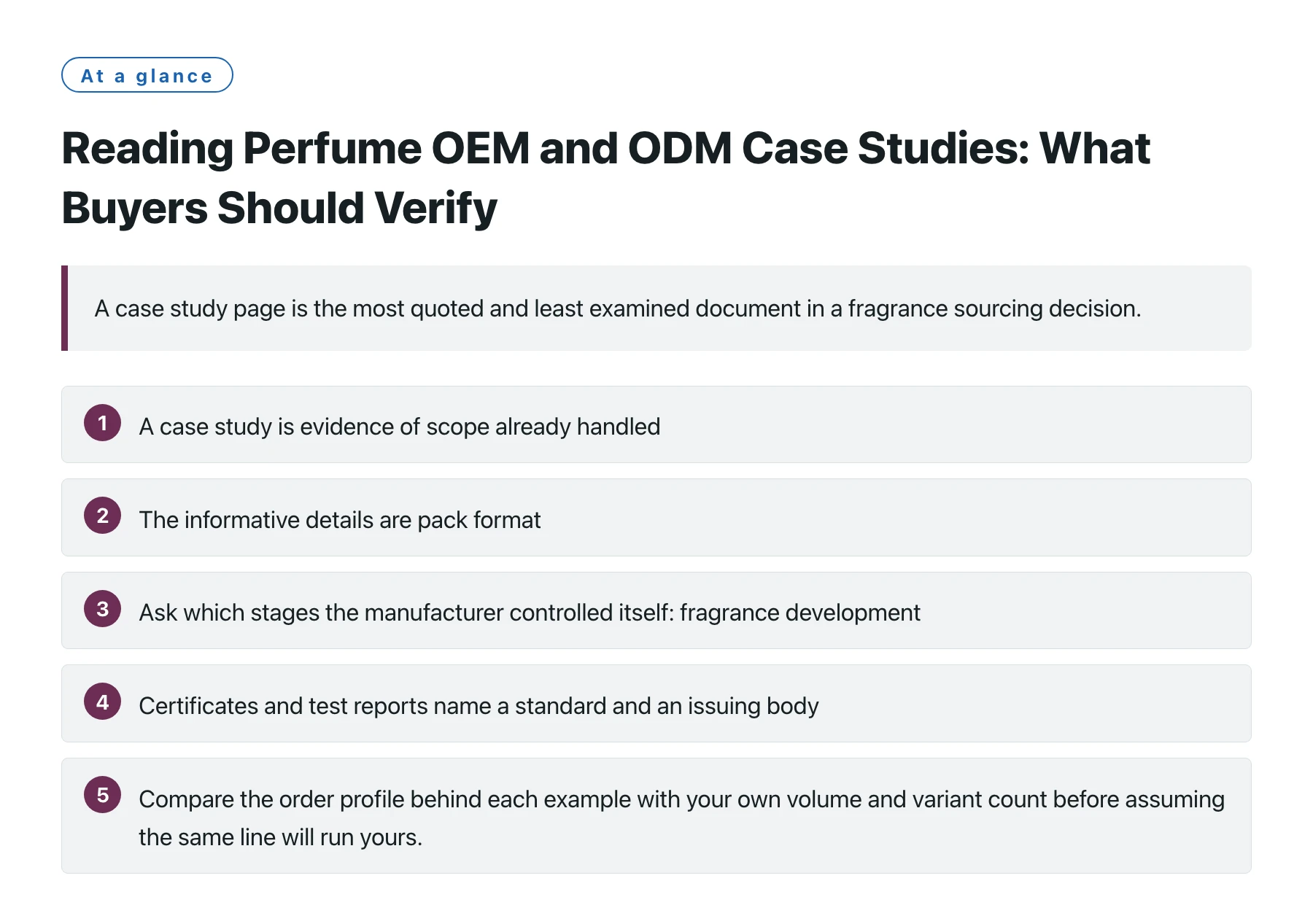
- A case study is evidence of scope already handled, not a forecast of how your own project will be delivered.
- The informative details are pack format, product category, target market and project shape, not the customer's name.
- Ask which stages the manufacturer controlled itself: fragrance development, filling, packaging sourcing, or only final assembly.
- Certificates and test reports name a standard and an issuing body, which makes them checkable rather than decorative.
- Compare the order profile behind each example with your own volume and variant count before assuming the same line will run yours.
Most buyers meet case studies at the wrong moment. They arrive after a first call, skim four cards with a photograph and a category label, and leave with a good feeling that has no structure behind it. The page did its job as marketing and did nothing for the decision.
That is worth fixing, because a well-built case study set does contain real information. It shows which categories the factory works in, which pack formats it fills, which export markets it ships to and how long a typical project takes from brief to shipment.
This guide sets out what the page can support, what it cannot, and the short set of questions that converts a marketing page into something you can shortlist against.
What a case study page can and cannot prove
A case study is a record, not a promise. It describes something that already happened, under conditions you cannot see: the state of the brief, the quality of the artwork, the number of rounds of sampling, and how quickly the brand made decisions. None of that transfers automatically to your project.
What does transfer is capability at a category level. If a manufacturer has repeatedly filled fine fragrance in glass with a crimped pump, or home fragrance in a ceramic vessel, that is a real signal about tooling, line configuration and the kind of problems its team has already solved.
Scope is the honest signal
The most reliable thing to read is breadth and depth of scope: which categories appear repeatedly, which pack formats recur, and whether the examples cluster around one market or spread across several. A narrow, deep set is often more informative than a long list of one-offs.
A well-maintained set of perfume OEM and ODM case studies usually gives you the category, the market and the format rather than the brand name, because most manufacturers cannot publish client identities without permission. That is normal, and it is not a reason to distrust the page.
Delivery evidence lives somewhere else
On-time delivery is a process outcome, and process outcomes show up in documents rather than in case cards: sampling turnaround records, approval-stage schedules, quality agreements and deviation logs. If a manufacturer cannot show you the shape of a schedule with named stages, the case studies are carrying more weight than they can bear.
Why customer names are often withheld
Fragrance projects sit close to a brand's roadmap. Even when a manufacturer would happily name a client, the client usually will not allow it, because the scent, the pack and the launch timing are competitive information.
So the absence of a logo is not evidence of a weak portfolio. The absence of any describable category, format or market is.
Four questions that turn a case study into usable evidence
| What to ask | Where the answer lives | What a solid answer looks like |
|---|---|---|
| Which stages did you run? | Written project outline | The manufacturer names the stages it controlled: fragrance development, filling, packaging sourcing, export paperwork |
| How close is my order profile? | Your own numbers, set beside theirs | Unit volume, pack format and variant count sit in the same range as the examples shown |
| Which standards apply to my product? | Certificates and test reports | Documents name the standard and the issuing body, and the scope covers your product category |
| What does the schedule look like? | Stage-by-stage plan | Sampling, approval, filling and shipping appear as separate dated stages rather than one total |
| How are changes handled mid-project? | Quality agreement or contract | There is a written route for formula changes, artwork revisions and the retesting they trigger |
The point of this table is not to collect documents. It is to move the conversation from what the factory has done onto what it will do for you, using the case study only as a starting point for questions that have checkable answers.
A practical way to vet delivery before you commit
- Separate scope from performanceWrite down what the case studies genuinely prove — categories, formats, markets — and what you are still assuming about schedule and quality.
- Match the closest example to your volumeFind the example whose pack format and volume band sit nearest your plan, and ask how that project was staffed and scheduled.
- Ask for the certificate scope, not the certificateA certificate that names a standard and an issuing body can be checked with that body; a scanned logo page cannot.
- Request one real schedule with datesAsk for a recent project timeline with sampling, approval and filling stages marked. Undated totals hide where the delays happen.
- Run a small paid trialA first small order tells you more about communication and document handling than any number of case cards ever will.
- Check the paperwork trailConfirm that specification sheets, safety documentation and packing lists arrive in the format your market requires before you scale.
The mistake that costs the most money is choosing a supplier because the case study set looks impressive and then discovering that your project sits outside the pattern entirely — a different format, a much smaller volume, a market the factory has never shipped to. None of that is fraud; it is simply a mismatch that the page could not show you. Write down which example is genuinely closest to your plan, and ask why. If the answer is vague, you have learned something important before spending anything.
Turning what you see into a shortlist
Once you have read a handful of case study pages with the same questions in hand, the comparison becomes much easier. You stop ranking suppliers by how polished the page looks and start ranking them by how closely the demonstrated scope overlaps your actual plan.
Score overlap, not reputation
Give each candidate a simple overlap score across four lines: pack format, product category, target market and order size. A supplier with strong overlap on three of four is usually a better first conversation than one with a famous name and no relevant example.
Where a candidate has no relevant example, ask what the closest project was and what would be new for them. An honest answer about a gap is more useful than a confident claim that everything is routine.
Bring your own constraints into the open
Case studies are read in one direction, but the useful conversation runs both ways. Tell the manufacturer your filing deadline, your packaging lead time and the markets you must be able to label for. Their reaction tells you whether the demonstrated capability actually reaches your project.
Independent testing bodies publish the standards they audit against and the scope of each service, which makes it possible to confirm that a claimed test report covers the specific product type you are buying [1]. Packaging design and structural elements can also be protected through registered designs and other intellectual property routes administered through national and international systems such as those coordinated by WIPO [2]. Both are worth raising early, while changes are still cheap.
Keep the evidence after the decision
Whatever you collect during vetting — schedules, certificate scopes, sample approval sheets — becomes the baseline you measure the project against. It is a fair request to make of any factory, and suppliers such as Xuelei in Guangzhou who run long production programmes tend to have those records on file already. A short file per supplier makes the first quality conversation far less emotional, because both sides are looking at the same documents.
That habit also protects you at renewal. When a formula is transferred to a new filling site or a pack material changes, the original approval record is what tells you whether anything that mattered has moved.
Sources
- SGS: Cosmetics, Personal Care & Household Testing —— Testing, inspection and certification services for cosmetics and personal care, including microbiological, stability and safety testing aligned with cosmetics GMP.
- WIPO — World Intellectual Property Organization —— The UN agency for intellectual property; resources on industrial design and patent protection relevant to product and packaging design.
Frequently asked questions
Are case studies reliable evidence of a manufacturer's quality?
They are evidence of scope, not of quality. A case study can show which categories and pack formats a factory has handled, but quality is demonstrated by specifications, test reports and the results of a first production run. Treat the page as a reason to ask better questions.
Why do most perfume manufacturers not name their clients?
Because fragrance projects sit close to a brand's launch plans. Scent, packaging and timing are competitive information, so clients usually refuse permission even when the manufacturer would like to publish the name. The missing logo is normal; missing category detail is not.
What is the most useful single question to ask about a case study?
Ask which stages the manufacturer controlled itself. A factory that developed the formula, filled the product and sourced the pack is offering a different service from one that only assembled components it was sent. That answer tells you where the real risk sits.
Should a small brand worry that every example is much larger than its order?
It is worth checking, because line setup and minimum batch sizes are usually built around the typical order. Ask what the smallest project on that format looked like and how it was scheduled. If the answer is that small runs are handled in a separate way, ask to see that process.
How many reference projects should a brand review before deciding?
Three or four genuinely comparable examples are more useful than twenty unrelated ones. The goal is not volume but overlap: find the projects closest to your format, category and market, then focus your questions on how those were run from brief to shipment.