Twelve Years for 0.1 BTC: What a Small KAS Rig Really Earns
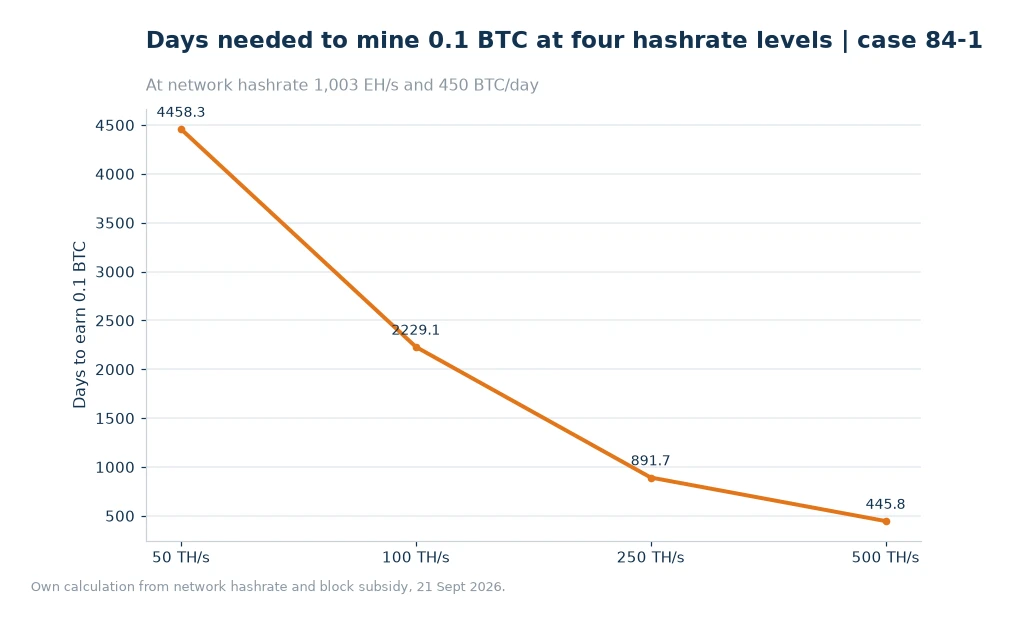
Small KAS rigs are cheap to buy and slow to accumulate, and the arithmetic is blunt about it. At 50 TH/s of BTC-equivalent work, 0.1 BTC sits 4,458.3 days away, which is 12.2 years; at 500 TH/s the same target takes 445.8 days. Knowing which end of that range you are on is more useful than knowing the machine's rated hash.

Key takeaways
- 0.1 BTC takes 4,458.3 days at 50 TH/s and 445.8 days at 500 TH/s.
- 0.1 BTC is $8,469.20 at $84,692, or roughly 205,000 KAS at $0.04130647.
- The days figure uses BTC network inputs, so it is a value ruler rather than a KAS difficulty forecast.
- KAS is one of 20+ coins on the same account, which keeps the payout side simple even when the rig is small.
A coin with its own network, on someone else's account
KAS is mined on its own chain with its own difficulty, and a rig pointed at it earns KAS rather than bitcoin. That matters for everything except the comparison in this article. The pool hosts KAS alongside BTC, BCH, LTC/DOGE, ZEC, HNS, CKB, ETC and others, so a miner can hold one account and one set of payout addresses while the underlying chains stay separate.
The convenience is real but limited: a multi-coin pool does not merge the networks, it just collects the work and credits the right balance. A KAS miner still has to think about KAS difficulty, KAS price and the KAS side of the market. The BTC-equivalent view below answers a different question, which is what the same effort is worth in the unit most miners use to compare operations.
The BTC-equivalent ruler and what it assumes
The formula behind the chart is the standard one: your hashrate divided by the network hashrate, multiplied by 450 BTC a day. Here the network figure is the BTC network at 1,003 EH/s, not the KAS network, so the result is the BTC value of a given amount of hash at BTC difficulty. It is a ruler, not a forecast of KAS output.
Read that way, the numbers are still useful. They answer whether a machine's daily value is large enough to cover its power and its share of a capital budget, using the same inputs for every row. A KAS-specific projection needs the KAS difficulty and the KAS price, and the pool's calculator is the place to get those rather than a table written on a fixed date.
Four levels, and how long they take
The table holds 0.1 BTC fixed and moves the hashrate. The years column is the days figure divided by 365, which is the unit most people use when deciding whether a target is realistic.
| Hashrate | Daily BTC | Days to 0.1 BTC | Years |
|---|---|---|---|
| 50 TH/s | 0.000022433 | 4,458.3 | 12.2 |
| 100 TH/s | 0.000044865 | 2,229.1 | 6.1 |
| 250 TH/s | 0.00011216 | 891.7 | 2.4 |
| 500 TH/s | 0.00022433 | 445.8 | 1.2 |
Twelve years is longer than the useful life of most hardware, which is the honest conclusion for the top row. A 50 TH/s machine will be replaced twice before the target arrives, and each replacement changes the arithmetic. The bottom row is inside a single hardware generation, which is the practical boundary for planning in years rather than months.
Worked example
Follow 50 TH/s from the network down to the target, then convert to both currencies.
- 450 BTC a day ÷ 1,003,000,000 TH/s = 0.00000044865 BTC per TH/s per day.
- 50 TH/s × 0.00000044865 = 0.000022433 BTC a day.
- 0.1 BTC ÷ 0.000022433 = 4,458.3 days.
- 4,458.3 ÷ 365 = 12.2 years.
- 4,458.3 × 24 = 106,999 hours of continuous running.
- At 250 TH/s: 0.00011216 BTC a day, so 0.1 ÷ 0.00011216 = 891.7 days, or 2.4 years.
- At 500 TH/s: 0.00022433 BTC a day, so 445.8 days, or 1.2 years.
- Value: 0.1 × 84,692 = $8,469.20, and 8,469.20 ÷ 0.04130647 = about 205,000 KAS.
Why the slow rows are not automatically bad
A twelve-year target sounds absurd until the capital cost is put beside it. A small KAS rig that costs a few hundred dollars and draws a kilowatt is a different proposition from a 500 TH/s machine costing thousands. The slow row can still make sense if the power is cheap and the hardware is already owned; it stops making sense when it is financed at a rate that assumes a fast return.
The other consideration is optionality. A rig earning KAS can be redirected, sold, or repurposed, and a twelve-year projection is not a commitment to run for twelve years. The number tells you the direction and the order of magnitude. Decisions about whether to keep going are better made every quarter against actual credits than once against a forecast.
The pool reading that pairs with a slow target
When the target is years out, a single bad week is noise and a single good week is not a trend. What matters is whether the pool's share of the network is stable and whether its block count is tracking expectation over months. A pool whose share shrinks steadily is one where your slice of the same work buys less of the group's output, even if your per-terahash rate is unchanged.
The ViaBTC KAS Mining Pool page shows those group-level readings next to the coin-level detail, so a KAS miner can check both without leaving the account. Under PPS+, the default, the block-reward component settles hourly at a listed 4%, which suits a slow target because it removes the pool-luck swings from the monthly numbers. Under PPLNS the listed rate is 2% on the combined reward and fees, with the variance carried by the miner.
Hardware age is the variable that decides this
A machine's efficiency falls behind the fleet every year, and a long target assumes the machine stays competitive for its whole life. The fix is not a better forecast but a shorter review cycle: compare the rig's daily credit with the credit a current model would produce at the same power draw, and decide whether the difference pays for a replacement.
For the 50 TH/s row that comparison usually arrives quickly. For the 500 TH/s row it may not arrive inside the target window at all, which is another way of saying the faster rows are more robust to hardware drift rather than merely quicker. A rig that is already two generations behind will not age into a better position, so the review is worth scheduling before the target rather than after it.
Frequently asked questions
How long does 0.1 BTC take at 50 TH/s?
About 4,458.3 days at a 1,003 EH/s BTC network, which is 12.2 years of continuous running and 0.000022433 BTC a day before fees.
Does this article forecast KAS output?
No. The days figure is a BTC-equivalent ruler built on BTC network inputs; a KAS projection needs the KAS network difficulty and the KAS price, which the pool's calculator reads at the time you use it.
What is 0.1 BTC worth in KAS?
At $84,692 per BTC and $0.04130647 per KAS, 0.1 BTC is $8,469.20, which is roughly 205,000 KAS before any conversion cost.
Decide with the slow row in view
Start at the bottom of the table and ask whether twelve years is acceptable. If it is not, the answer is more hashrate or a smaller target, and both are decisions rather than discoveries. If it is acceptable, the plan needs a quarterly review and a power contract that will not move against it.
The Profit Calculator will rebuild the daily figure with current KAS and BTC prices, and the multi-currency wallet keeps the KAS balance and any BTC balance in one view. Run both before the purchase, then again when the first quarter closes.
Sources: the ViaBTC state, calculator and wallet pages, with chain data read 21 Sept 2026[1]. BTC network hashrate 1,003 EH/s, difficulty 132.76 T, 3.125 BTC per block, 144 blocks a day, BTC $84,692, KAS $0.04130647. Published 22 Oct 2026; day counts assume continuous uptime.