Why Pool Hashrate Drops and What Happens to Your Payout
Pool hashrate falls for four ordinary reasons: power economics, scheduled curtailment, miners redirecting to another pool, and hardware retirement. What that does to your payout depends almost entirely on which payment method you chose. With 1 PH/s pointed at the pool, PPS+ credits about 0.00001973 BTC an hour — roughly $1.68 at $85,294 per BTC — whether the pool is growing or shrinking, because that component is settled per accepted share rather than from a split of whatever the pool happens to find.

Key takeaways
- At 20 J/TH a rig needs 0.48 kWh per TH/s per day, so the gross breakeven power price is $0.0841/kWh and $0.0808/kWh after the listed 4% fee on the block-reward component.
- The same arithmetic at 15 J/TH gives a breakeven of $0.1122/kWh gross and $0.1077/kWh net — that spread is why efficient fleets stay online when inefficient ones leave.
- PPS+ keeps paying 1 PH/s at 0.00001973 BTC an hour through a pool-hashrate drop; PPLNS does not, because each distribution waits for a block and 6 confirmations.
- The fee difference matters more than the hashrate blip: 4% versus 2% on the block-reward part is about $24.23 a month at 1 PH/s.
Four reasons hashrate leaves
Power economics. A machine with 20 J/TH efficiency consumes 0.48 kWh per TH/s per day. Gross income is $0.0404 per TH/s per day at current difficulty and price, so the breakeven power price is $0.0841/kWh before fees and $0.0808/kWh after the listed 4% on the block-reward component. A site paying more than that hashes at a loss, and it stops. At 15 J/TH the same numbers become $0.1122 and $0.1077, which is why a pool tends to lose its least efficient hashrate first and gets it back last.
Curtailment. Sites with flexible power contracts sell capacity back to the grid during peak hours. The hashrate is not gone; it is scheduled to return, and it usually returns in a predictable block of hours rather than gradually.
Redirects. A firmware update, a failover configuration, or a deliberate test can move a whole farm to a different endpoint in minutes. This shows up as a step change rather than a slope, and it is the drop most likely to reverse within a day.
Retirement and refresh. Old machines do not fail all at once. They get switched off in batches as replacements arrive, so a gentle downward slope in pool hashrate can simply be an industry-wide hardware rotation that no single operator controls.
What a drop does not change
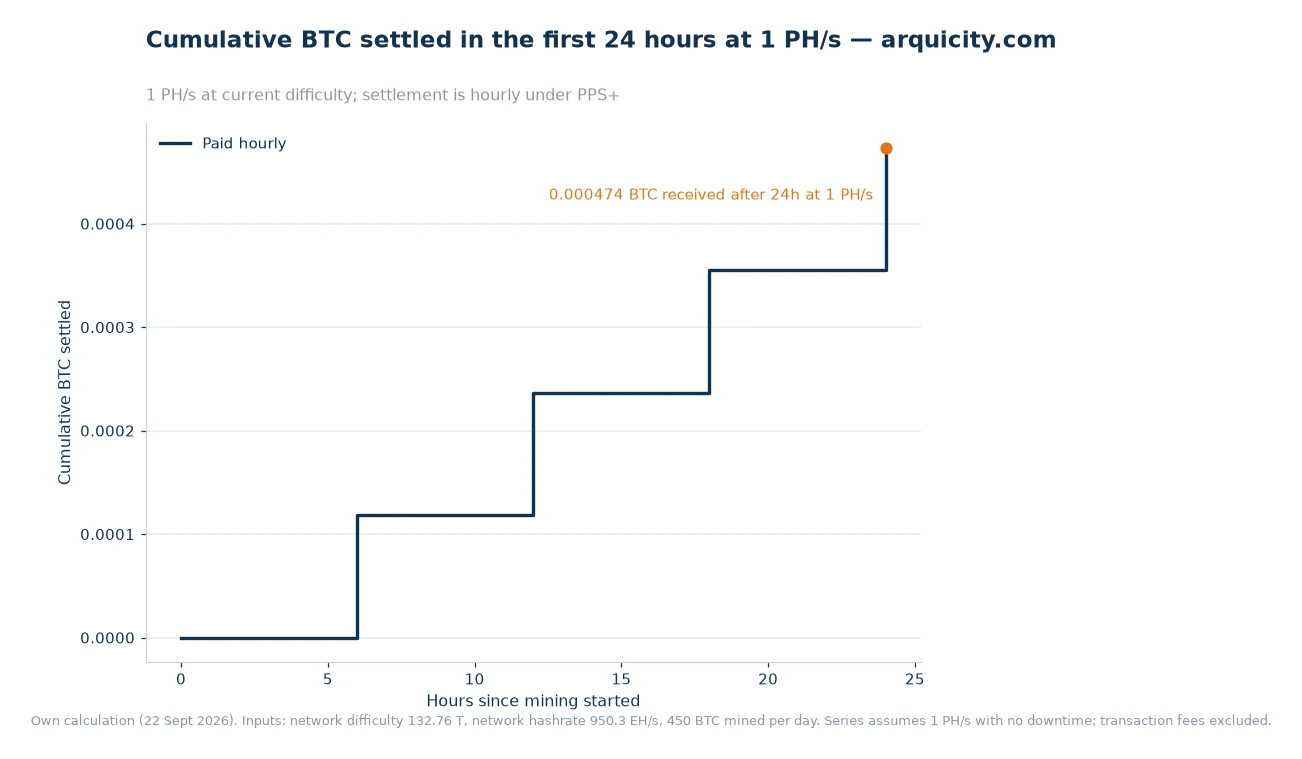
Under PPS+, the block-reward component of a payout is settled per accepted share at current difficulty and paid every hour. The pool's total hashrate never enters that calculation. Your own 1 PH/s is measured against the network, so the credit you receive is the same in a quiet pool as in a busy one: 0.00001973 BTC an hour, or 0.00047353 BTC a day at present difficulty and a $85,294 price.
That has a practical consequence for anyone monitoring a state page. A falling pool hashrate figure is not automatically bad news for your balance, and a rising one is not automatically good news. On PPS+ the two numbers are close to independent, and the thing worth watching is your own submitted hashrate and share acceptance rate.
What it does change
Two things move. First, the number of blocks the pool expects to find: fewer contributing miners means fewer blocks, which matters directly to PPLNS miners, whose distribution only exists once a block is found and confirmed six times. Second, the transaction-fee component, which is collected when blocks are mined and distributed with PPLNS logic; a thinner block stream makes that slice lumpier as well as smaller.
There is also a second-order effect on how the pool looks. Pool Luck is found blocks divided by expected blocks, and expected blocks are derived from the pool's own hashrate. When hashrate is falling, the luck figure is comparing a period's realised blocks against an average of a moving denominator, so it can read oddly for a week after a large operator leaves.
| What the drop affects | PPS+ | PPLNS |
|---|---|---|
| Hourly credit at 1 PH/s | Unchanged at 0.00001973 BTC while difficulty holds | No hourly credit; value accrues until a block is found |
| Timing of settlement | Every hour at current difficulty | After 6 confirmations on a block the pool found |
| Block-reward fee | Listed 4% on the PPS-settled part | Listed 2% merged with the fee component |
| Fee-component collection | Distributed with PPLNS logic, listed 2% | Merged with the block reward, listed 2% |
| Who carries block-timing risk | The pool | You, measured over the last 5 difficulty rounds |
Worked example: 1 PH/s through a halving of pool hashrate
Start with 1 PH/s on PPS+ and a pool that loses half its hashrate overnight. Nothing about your hardware or the network changed: difficulty is still 132.76 T and the network still produces 450 BTC a day, worth about $38,382,300. Your share of the network is 1.05 × 10⁻⁶, which yields 0.00047353 BTC a day, and the hourly credit stays at 0.00001973 BTC — about $1.68 — for all 24 hours of the next day.
Move the same rig to PPLNS and the arithmetic changes shape. The pool now finds half as many blocks, so distributions arrive half as often, and each one is split by your share of pool hashrate across the last 5 difficulty rounds. Your share of the pool doubles, your share of the network does not, and the expected monthly total converges towards the same figure — but the path there becomes a staircase with wide, irregular steps. A week with no distribution is not a loss; a month with no distribution is worth investigating.
Confirming what actually happened
Before reacting to a hashrate drop, check three things in order: your own submitted hashrate, the network difficulty, and the pool's published figures. The state page shows ViaBTC Pool Hashrate beside network hashrate and the next adjustment estimate, which is the fastest way to separate a pool-side change from a network-wide one. If the movement is pool-side only, the weekly pool statistics show whether it came from one large departure or many small ones.
Then decide whether to do anything at all. For a PPS+ miner the honest answer is usually nothing: the credit keeps arriving on the same hourly cadence, and switching pools mid-drop changes the fee component without changing the block-reward maths. The scenario where action pays is a PPLNS miner whose pool has lost so much hashrate that blocks, and therefore distributions, have become genuinely rare.
Frequently asked questions
Will my payout fall if the pool loses hashrate?
On PPS+ the block-reward component does not, because it is settled per accepted share at current difficulty. On PPLNS it can be delayed substantially, since distributions depend on the pool finding blocks and waiting for 6 confirmations.
What power price makes a machine uneconomic?
At 20 J/TH, 0.48 kWh per TH/s per day against $0.0404 of gross income per TH/s per day puts the gross breakeven at $0.0841/kWh and the post-fee breakeven at $0.0808/kWh. A 15 J/TH machine reaches $0.1122 and $0.1077.
Is a smaller pool better for a small miner?
Not by itself. A smaller pool means fewer expected blocks and lumpier timing under PPLNS, while PPS+ returns the same per-share value at any pool size. What matters is the listed fee on each component, uptime, and how often you get paid.
Check the cause before changing anything
Write down your own hashrate, your submitted share rate and your credited BTC for the week, then compare them against the pool's published totals. If your numbers held and the pool's did not, the drop belongs to someone else's power contract, and no action on your side improves it. If your numbers moved, fix your own side first, and only then look at whether the payment method still suits the hashrate you actually run.
Data and sources: ViaBTC fee schedule and payment-method documentation[1], pool statistics pages[2] and the earnings calculator[3]. Network difficulty 132.76 T, implied network hashrate 950.3 EH/s, the 3.125 BTC block subsidy, 144 blocks per day, an estimated next adjustment of +1.90% and a BTC price of $85,294 were read from public chain data and market feeds, read 22 Sept 2026. All figures are arithmetic on those inputs, not a promise of earnings.